


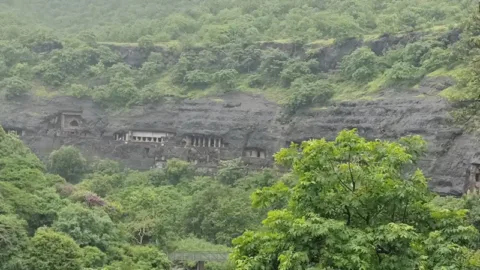
The Ajanta Caves are a set of 30 Buddhist caves cut into a horseshoe-shaped basalt cliff above the Waghora river in Maharashtra. Inside are some of the finest surviving paintings of ancient India, and this one-day guide covers their history, the caves worth your time, and how to get around the site.
A Brief History of the Ajanta Caves
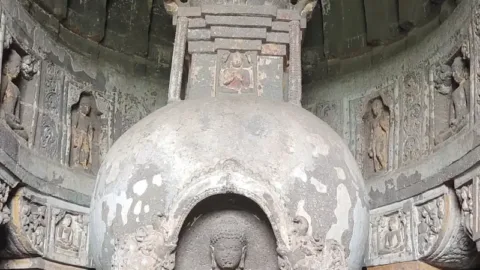
The first phase (2nd–1st century BCE): Buddhist monks began carving here under the Satavahanas. These early caves, including the prayer halls 9 and 10, show the Buddha only through symbols like the stupa, never in human form.
The golden phase (5th century CE): After a gap of about 600 years, work resumed under the Vakataka emperor Harishena. Within roughly two decades, ministers, nobles and monks sponsored most of the caves you see today. Cave 16 was gifted by the minister Varahadeva and Cave 17 by the local ruler Upendragupta. The Buddha now appears as a sculpted and painted figure, and the walls fill with Jataka tales, stories of the Buddha’s earlier lives.
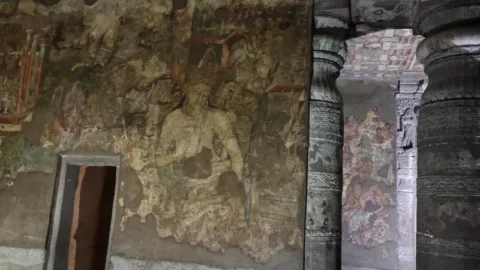
How the caves were used: The caves are of two kinds. Viharas were monasteries where monks lived and studied, especially during the monsoon. Chaityas (Caves 9, 10, 19, 26 and 29) were prayer halls built around a stupa. The murals were painted on a layer of clay, cow dung and rice husk, using mineral colours and even imported lapis lazuli for the blues.
Abandoned and rediscovered: After Harishena’s death, work stopped abruptly, which is why some caves are left half-carved. The forest slowly hid them for over a thousand years. In April 1819, a British officer, John Smith, came upon Cave 10 while hunting a tiger and scratched his name on one of its pillars. You can still spot it today.
Today, the caves are protected by the Archaeological Survey of India and have been a UNESCO World Heritage Site since 1983, along with the Ellora Caves nearby.
Explore more destinations across India in our Discover India page.
Ajanta Caves: Plan Your Visit
Trip Snapshot
- Ajanta, Maharashtra
- October - March
- 1 day (3-6 hrs at the caves)
- 2000 - 5000/day
- Chh. Sambhajinagar Airport
Must-See Caves
- Cave 1 – Padmapani Mural
- Cave 2 – Painted Ceilings
- Cave 4 – Largest Monastery
- Cave 16 – Dying Princess
- Cave 17 – Jataka Murals
- Cave 19 – Carved Façade
- Cave 26 – Reclining Buddha
Know Before You Go
- Closed on Mondays
- Open 9 am – 5 pm
- No Flash Photography
- Weak Mobile Network
- Shuttle from Parking
Things to Do & See
- Upper View Point Walk
- Waghora River Bridge
- Cave-by-Cave Heritage Walk
- Café & Craft Shops
- Silk Weaving

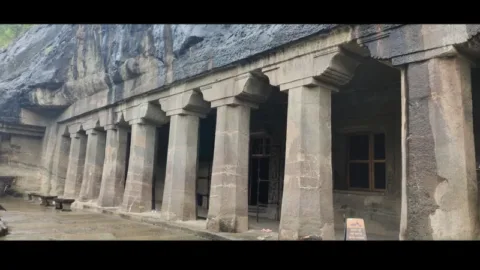
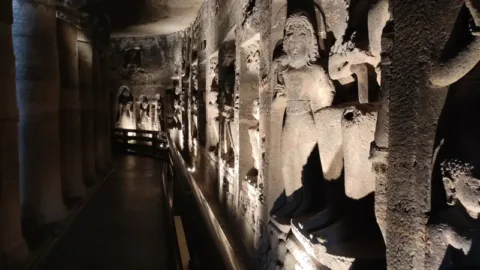
Why Visit the Ajanta Caves?
The caves lie in the Chhatrapati Sambhajinagar district (formerly Aurangabad), about 100 km north of the city, near the village of Fardapur. They are carved along a steep gorge where the Waghora falls from a series of seven pools, known as Saptakund.
Few places let you walk through 800 years of art in a single morning. From simple early prayer halls to richly painted monasteries, the Ajanta Caves show how Buddhist art grew in India, and why historians and artists from across the world still travel here. It makes an ideal heritage day trip from Chhatrapati Sambhajinagar.
How to Reach the Ajanta Caves
- Chhatrapati Sambhajinagar (Aurangabad) Airport – nearest airport, about 100 km (2.5–3 hours by road)
- Chhatrapati Sambhajinagar (Aurangabad) Railway Station – nearest railhead, about 105 km (2.5–3 hours)
- Jalgaon Junction – about 60 km, handy if you are coming from north India
- From Mumbai – about 450 km, 7–8 hours via the Samruddhi Expressway
- From Pune – about 340 km, 7–8 hours
- From Nashik – about 260 km, 5–6 hours
- From Hyderabad – about 600 km; flying or taking a train to Chhatrapati Sambhajinagar is easier
Most travellers stay in Chhatrapati Sambhajinagar and hire a taxi for the day, which costs around ₹2,500 for the round trip, depending on the car and the number of people. Private vehicles stop at the T-junction parking near Fardapur, about 4 km before the caves. From here, shuttle buses (about ₹40 per person) take you to the main entrance.
Best Time to Visit the Ajanta Caves
- October to March: cool weather, ideal for walking between the caves
- July to September: a green gorge and the Saptakund waterfall in full flow, but wet steps
- April to June: very hot; visit only early in the morning
We visited at the end of July, when the Waghora was flowing and the whole valley was green.
Ajanta Caves: How to Enter and Get Around
There are two ways into the Ajanta Caves. Both work well, and the return to your car is always by the shuttle bus from the main entrance.
Option 1: Via the Main Entrance
- Drive to the T-junction parking near Fardapur and take the shuttle bus to the caves (about 10 minutes).
- The shuttle drops you at the café and shopping area. Buy or show your ticket and climb the steps to Cave 1.
- Walk the caves in number order, then retrace the path to the exit.
Option 2: Via the Upper View Point
- Ask your driver to drop you at the Ajanta Caves View Point, a few kilometres before the main parking. Spend 5–10 minutes taking in the full horseshoe of caves.
- Send your driver to the T-junction parking to wait for you. Since this means an extra drop and pickup, your taxi driver may charge a little extra.
- Facing the caves, take the stone stairway on the right. It’s a steady downhill walk of about 20–25 minutes to a small shelter, the Lower View Point. In the monsoon, a small waterfall sits just off the path.
- Continue down another 10–15 minutes to the Waghora river and cross the blue footbridge.
- Show your ticket at the check post near Cave 8, and you are on the main cave path. Book it beforehand on the ASI website.
The steps on this route can get slippery in the monsoon, so wear shoes with a good grip and take it slow.
Getting Around Inside
- A single paved path with steps runs along the cliff, linking Cave 1 to Cave 26.
- The Upper View Point route is downhill and avoids walking back; the climb back up is steep, so return by shuttle.
- Doli (palanquin chairs) are available near the entrance for elderly visitors.
- Wear slip-on shoes; you may need to remove them or use shoe covers at the painted caves.
Where to Stay
- Chhatrapati Sambhajinagar has the widest choice of hotels and also suits a visit to Ellora.
- Stay near Fardapur if you want to be at the gates at 9 am.
Ajanta Caves Timings, Tickets & Rules
- Timings: 9 am to 5 pm, closed on Mondays
- Indians, SAARC & BIMSTEC visitors: ₹40 (₹35 online)
- Foreign visitors: ₹600 (₹550 online)
- Children under 15: free
- Shuttle bus: about ₹40 per person from the T-junction parking
Book your tickets in advance on the official ASI ticket booking website and save a screenshot or PDF, as the mobile network is very weak at the caves. For more visitor details, see the ASI page on Ajanta.
Mobile photography is allowed, but flash is strictly not allowed, as it damages the paintings. Don’t touch the walls, and keep food and drinks outside the caves.
Keep some cash handy for the shuttle and tickets, as the network sometimes doesn’t work and online payments can fail.
Ajanta Caves: Top Places to Visit
With 30 caves, it helps to know where to slow down. These are the Ajanta Caves you shouldn’t miss, even on a short visit.
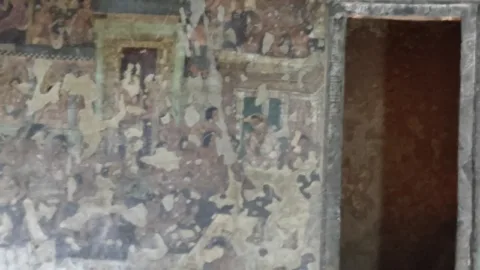
Cave 1
Home to the Padmapani and Vajrapani paintings and vivid Jataka murals.
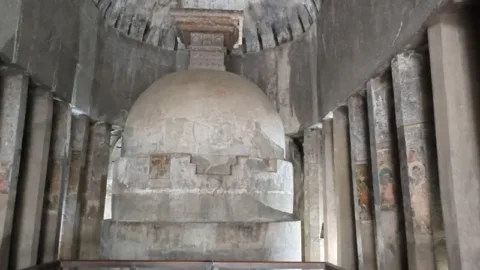
Cave 10
One of the oldest prayer halls, carved around the 2nd century BCE.
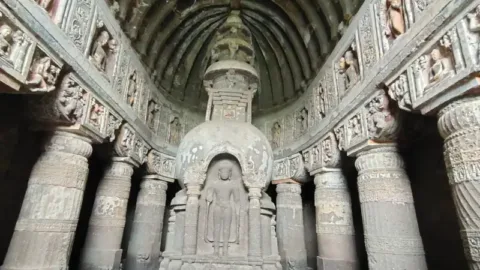
Cave 19
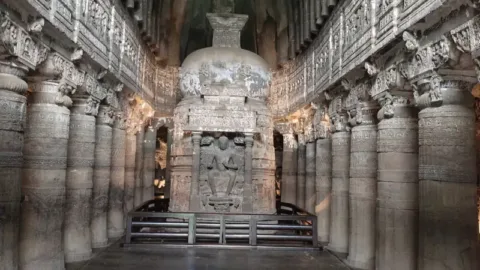
A 5th-century prayer hall with a richly carved façade and stupa.
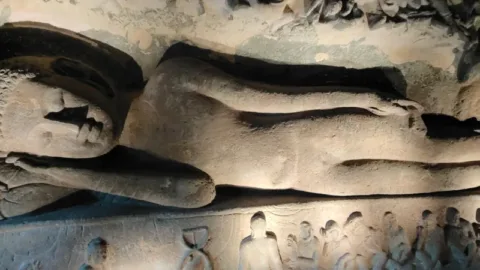
Cave 26
The grand finale, with the reclining Buddha and the Temptation of Mara.
Also Visit
Cave 4, the largest monastery at Ajanta, with a pillared hall and a large seated Buddha.
Caves 6 and 7, including a rare two-storeyed monastery.
Cave 24, left unfinished, which shows how the monks carved the caves from top to bottom.
Read more about the site’s history on Wikipedia.
Explore more iconic landmarks and city guides in our Popular Destinations section
Ajanta Caves: What to See, Cave by Cave
The caves are numbered by their position along the cliff, not by age. Here is what to look for in the most important ones, with the time you need.
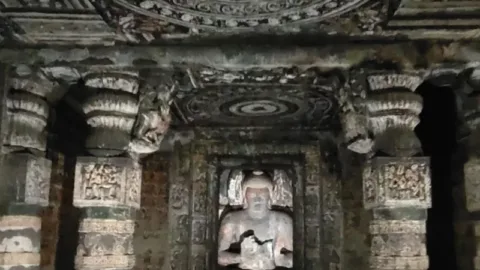
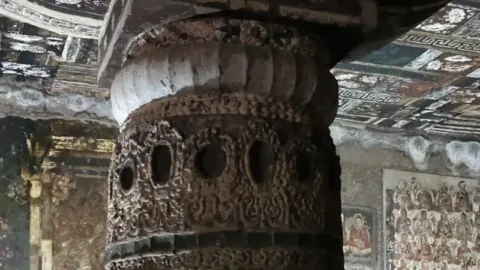
Caves 1 & 2: The Painted Monasteries
Cave 1 (30–35 minutes)
Probably the richest cave at Ajanta, from the late 5th century. On either side of the shrine are the famous Bodhisattvas Padmapani, holding a lotus, and Vajrapani, holding a thunderbolt. The walls carry Jataka tales and scenes of royal life, and the inner shrine holds a large seated Buddha teaching. Look up at a pillar to find four deer sharing a single head. Stand still for a few minutes inside; the paintings appear slowly as your eyes adjust.
Cave 2 (20–25 minutes)
Next door, with a similar layout but different stories. Its painted ceilings are the best preserved at Ajanta, full of flowers, birds and circular patterns. Find the small shrine of Hariti, a goddess of children, with her husband Panchika, and the panels on the Buddha’s birth.
Caves 16, 17 & 19: The Vakataka Masterpieces
Cave 16 (20 minutes)
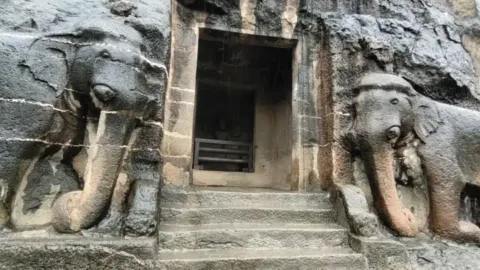
Gifted by Varahadeva, a minister of Harishena, whose long inscription survives here. Two stone elephants guard the steps up to it. Inside is the famous painting known as the ‘Dying Princess’, showing Sundari fainting on hearing that her husband Nanda had become a monk.
Cave 17 (25–30 minutes)
This cave has the largest number of surviving murals, with around 30 Jataka tales. Walk clockwise to follow the stories, and look up at the brightly painted verandah ceiling. Don’t miss the panel of a mother and child offering alms to the Buddha.
Cave 19 (10 minutes)
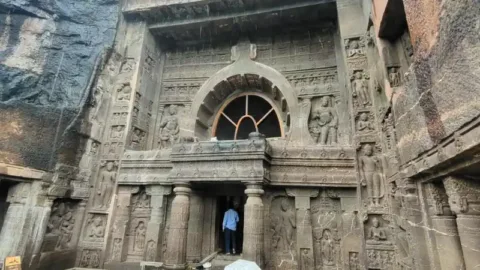
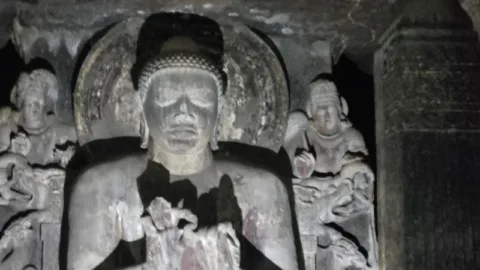
A small but perfect prayer hall from the 5th century. Its façade is covered with carved Buddhas around a large horseshoe-shaped window, and inside, a standing Buddha is carved into the front of the stupa. Outside, look for the Naga king seated with his queen.
Caves 9, 10 & 26: The Prayer Halls
Caves 9 and 10 (15–20 minutes)
Among the oldest caves at Ajanta, from the 2nd–1st century BCE. These long vaulted halls with a plain stupa show early Buddhist worship, before the Buddha was carved in human form. Cave 10 is where John Smith left his name in 1819.
Cave 26 (25–30 minutes)
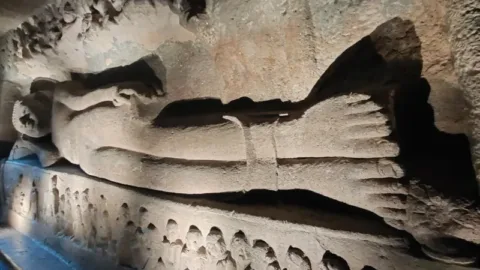
The grand finale. This late 5th-century prayer hall is packed with sculpture. Along the left wall lies the reclining Buddha, about 7 metres long, at the moment of his passing into nirvana, with mourners below. Nearby is a large panel of the Temptation of Mara, where the demon’s army and daughters try to distract the meditating Buddha.
Ajanta Caves: Silk Stores & Weaving
Café & Shops at the Entrance
Where the shuttle drops you, there is a small restaurant and café for tea, snacks and simple meals, along with a row of shops. You can buy books on Ajanta, postcards, souvenirs and local stone crafts here. Eat before you enter, as food is not allowed in the caves.
Silk Stores on the Way Back
The road back to Chhatrapati Sambhajinagar has several silk and handloom stores selling Paithani and Himroo sarees, shawls and fabrics. Some, like Mughal Silk Store, have a small weaving section where you can watch artisans at the handloom. It’s a pleasant way to end a heritage day.
Ajanta Caves: One-Day Itinerary
Morning: Leave Chhatrapati Sambhajinagar by taxi at 7 am to beat the city traffic. Stop for breakfast on the way at Sree Krishna Pure Veg in Balapur or Ajanta Green Restaurant & Resort in Fardapur. Carry snacks and water, and wear easy clothes and comfortable shoes.
9:30 am: Take the shuttle from the parking area to the main entrance, or enter through the Upper View Point. Then follow this 3–4 hour plan:
- Cave 1 (30 to 35 minutes)
- Cave 2 (20 to 25 minutes)
- Caves 3 to 7 (10 to 15 minutes), with a quick look at Cave 4
- Caves 9 and 10 (15 to 20 minutes)
- Cave 16 (20 minutes)
- Cave 17 (25 to 30 minutes)
- Caves 18 to 22 (10 to 15 minutes), with at least 5 to 10 minutes in Cave 19
- Cave 26 (25 to 30 minutes)
If you come down from the View Point, you join the path near Cave 8. See Caves 9 and 10 first, continue to 26, then walk back towards the exit and finish with Caves 1 and 2.
Have 6 hours? Add Caves 4, 6, 7, 11, 20, 21 and 24, and walk up to the Saptakund waterfall viewpoint in the monsoon.
Afternoon: Take the shuttle back to the parking and have lunch at Ajanta Green in Fardapur. On the way back, stop at one of the silk stores on the road to watch handloom weaving.
Dinner: Purnabramha on Jalna Road for an authentic Maharashtrian vegetarian thali.
Looking for short trips? Explore curated Getaways across India including beaches, forests, and heritage stays.
Ajanta Caves: Travel Tips
- Don’t plan your visit on a Monday
- Reach by 9:30 am, before tour buses arrive
- Save your e-ticket offline
- Carry cash for the shuttle and small purchases, as the network can be patchy
- Keep Ellora for another day; it’s closed on Tuesdays
With an early start and a clear route, one day at Ajanta feels complete, not rushed.
What stays with you after Ajanta is not just the scale, but the faces in the paintings: calm, graceful and still full of life after 1,500 years. Walking out into the gorge, it’s easy to see why monks chose this quiet bend of the river.
The stories behind India’s food culture add another layer to every journey, something we explore further in our Culinary Chronicles.
Exploring more of the region? Read our Ellora Caves guide and our Aurangabad travel guide with a 3-day itinerary.
Ajanta Caves FAQs
Here are some frequently asked questions about visiting the Ajanta Caves.
How much time do you need for the Ajanta Caves?
Plan 3–4 hours to see the key caves (1, 2, 16, 17, 19 and 26), or about 6 hours to see most of them. With travel from Chhatrapati Sambhajinagar, it is a full-day trip.
Which day are the Ajanta Caves closed?
The Ajanta Caves are closed on Mondays. They are open from 9 am to 5 pm on all other days. The nearby Ellora Caves are closed on Tuesdays.
What is the entry fee for the Ajanta Caves?
Tickets cost ₹40 for Indians and SAARC or BIMSTEC visitors (₹35 online) and ₹600 for other foreign visitors (₹550 online). Children under 15 enter free. The shuttle bus from the parking is extra. Tickets can be booked online on the official ASI website, asi.payumoney.com.
Can you take photos inside the Ajanta Caves?
Yes, mobile photography is allowed inside the caves, but flash is not allowed as it damages the ancient paintings.
What is the nearest railway station and airport to the Ajanta Caves?
The nearest railhead is Chhatrapati Sambhajinagar (Aurangabad) Railway Station, about 105 km away, and the nearest airport is Chhatrapati Sambhajinagar Airport, about 100 km away. Taxis are easily available from both.
Discover more from CookingTantra
Subscribe to get the latest posts sent to your email.