

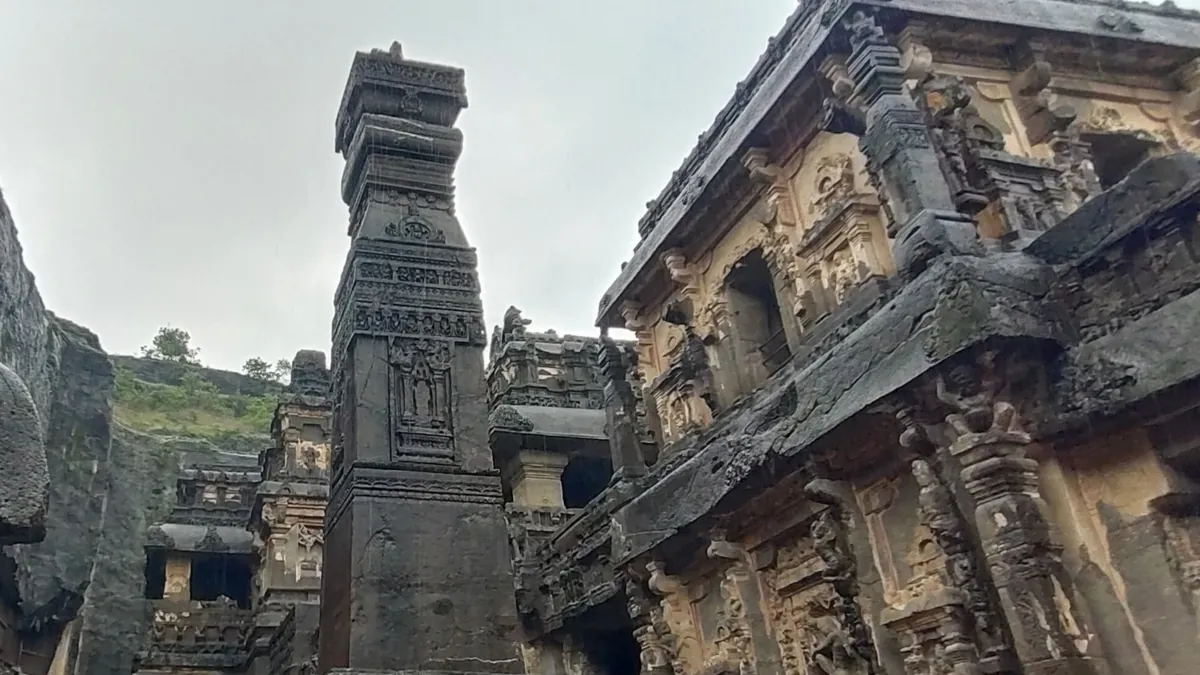
The Ellora Caves are a group of 34 rock-cut caves carved into a basalt hillside near Chhatrapati Sambhajinagar in Maharashtra. Buddhist, Hindu and Jain monuments stand side by side here, and at the centre is the Kailasa Temple, the largest single rock-cut structure in the world. This one-day guide covers their history, the caves worth your time, and how to get around.
A Brief History of the Ellora Caves
An ancient trade route: Ellora, known in old texts as Verul, lay on a busy route linking the ports of the west coast with the Deccan. Monks, merchants and pilgrims passed this way, and over about five centuries, from roughly 600 to 1000 CE, three faiths carved their shrines into the same two-kilometre stretch of cliff.
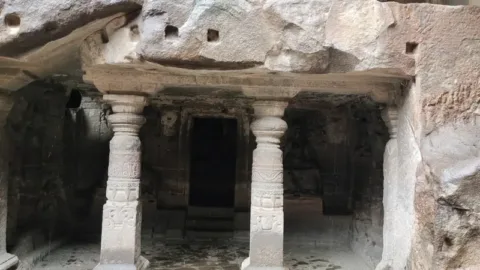
The Buddhist caves (about 600–730 CE): Caves 1 to 12, at the southern end, are the earliest. Most are viharas, or monasteries, where monks lived and studied. Cave 10 is the only prayer hall among them, and Cave 12 rises three storeys high.
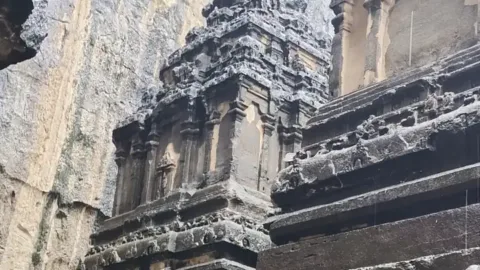
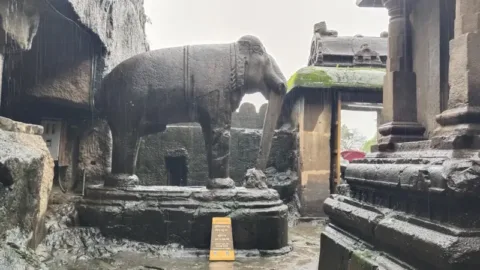
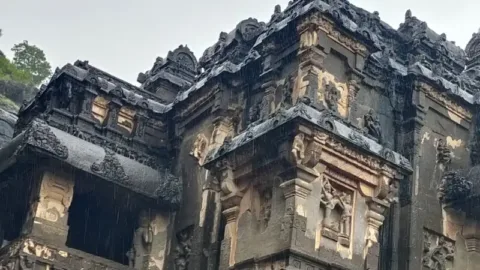
The Hindu caves (about 600–870 CE): Caves 13 to 29 are filled with scenes of Shiva and Vishnu. Their high point came under the Rashtrakuta dynasty. King Krishna I (about 756–773 CE) is credited with the Kailasa Temple (Cave 16), cut from the top of the hill downwards out of a single rock. Around 200,000 tonnes of stone were removed to free a full temple, complete with courtyard, bridges, pillars and life-size elephants.
The Jain caves (about 800–1000 CE): Caves 30 to 34, at the northern end, are the last chapter. They belong to the Digambara sect and are known for their fine, detailed carving, best seen in the two-storeyed Indra Sabha (Cave 32).
A living landmark: Unlike Ajanta, Ellora was never forgotten. Travellers and pilgrims described it through the centuries, even as some sculptures were damaged over time. Today the caves are protected by the Archaeological Survey of India and have been a UNESCO World Heritage Site since 1983, along with the Ajanta Caves.
Explore more destinations across India in our Discover India page.
Ellora Caves: Plan Your Visit
Trip Snapshot
- Ellora, Maharashtra
- October - March
- 1 day (5-6 hrs at the caves)
- 2000 - 5000/day
- Chh. Sambhajinagar Airport
Must-See Caves
- Cave 10 – Vishvakarma
- Cave 12 – Teen Tal
- Cave 15 – Dashavatara
- Cave 16 – Kailasa Temple
- Cave 21 – Rameshwar
- Cave 29 – Dhumar Lena
- Cave 32 – Indra Sabha
Know Before You Go
- Closed on Tuesdays
- Open Sunrise to Sunset
- Battery Car to Jain Caves
- Lots of Steps
- Little Shade
Things to Do & See
- Kailasa from the Top
- Kailasa Galleries
- Monsoon Waterfall
- Three Faiths Walk
- Local Misal Pav
Why Visit the Ellora Caves?
Ellora is about 30 km northwest of Chhatrapati Sambhajinagar (formerly Aurangabad), close to the town of Khuldabad. The caves run in a long line along the face of the Charanandri hills, with Kailasa almost directly opposite the entrance.
Few places show three religions living side by side in stone. In a single morning, you move from quiet Buddhist monasteries to the drama of Kailasa and the delicate Jain halls. It makes an ideal heritage day trip from Chhatrapati Sambhajinagar, and pairs naturally with our Ajanta Caves guide.
How to Reach the Ellora Caves
- Chhatrapati Sambhajinagar (Aurangabad) Airport – nearest airport, about 35 km
- Chhatrapati Sambhajinagar (Aurangabad) Railway Station – nearest railhead, about 30 km
- From Mumbai – about 340 km, 7–8 hours
- From Pune – about 250 km, 5–6 hours
- From Nashik – about 180 km, 4 hours
- From Shirdi – about 100 km, 2.5 hours
- From Hyderabad – about 570 km; flying or taking a train to Chhatrapati Sambhajinagar is easier
From Chhatrapati Sambhajinagar, the drive takes 45 minutes to an hour, past Daulatabad Fort. A taxi for the morning is the easiest option, and state buses also run to Ellora. Unlike Ajanta, cars can park close to the main entrance.
Best Time to Visit the Ellora Caves
- October to March: cool weather, ideal for walking between the caves
- July to September: green hills and seasonal waterfalls beside the caves, but wet, slippery rock
- April to June: very hot; arrive at opening time
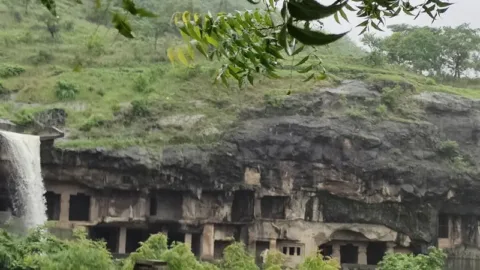
We visited at the end of July, when a waterfall was tumbling down the cliff next to the Hindu caves.
Ellora Caves: How to Enter and Get Around
Ellora has one main entrance, right opposite the Kailasa Temple. From here, the caves spread out on both sides along the cliff.
How the Site Is Laid Out
- Kailasa (Cave 16) is straight ahead as you enter.
- Buddhist caves (1 to 12) are on your right as you enter, towards the south, about a 10-minute walk away.
- Hindu caves (13 to 29) run on either side of Kailasa, with Cave 29 to the left, at the northern end near the waterfall.
- Jain caves (30 to 34) are on your left as you enter, about 2 km to the north, linked by a road and battery cars.
Best Way Around
- Start with the Buddhist caves, come back to Kailasa, then walk north to Caves 21 and 29.
- Take the battery car to the Jain caves, and ride it back to the entrance.
- You can also do it in reverse: take the battery car to the Jain caves first and walk back south. That is how we did it.
Kailasa from the Top
- A path from the left side of Kailasa climbs to the rim of the pit. From here, you see the whole temple from above and understand how it was carved downwards from the hill.
- The path is uneven and slippery in the monsoon, so go slowly.
Where to Stay
- Chhatrapati Sambhajinagar has the widest choice of hotels and is also the base for Ajanta.
- Stay near Khuldabad or Ellora if you want to be at the gates at opening time.
Ellora Caves Timings, Tickets & Rules
- Timings: sunrise to sunset (around 6 am to 6 pm), closed on Tuesdays
- Indians, SAARC & BIMSTEC visitors: ₹40 (₹35 online)
- Foreign visitors: ₹600 (₹550 online)
- Children under 15: free
- Battery car to the Jain caves: about ₹40 per person for the return trip
Book your tickets in advance on the official ASI ticket booking website and save a screenshot or PDF. One ticket covers all the caves, including Kailasa.
Photography is allowed. Don’t climb on or touch the sculptures, and keep food and drinks outside the caves. Carry some cash for the battery car and small purchases.
Ellora Caves: Top Places to Visit
With 34 caves and three faiths, it helps to know where to slow down. These are the Ellora Caves you shouldn’t miss, even on a short visit.
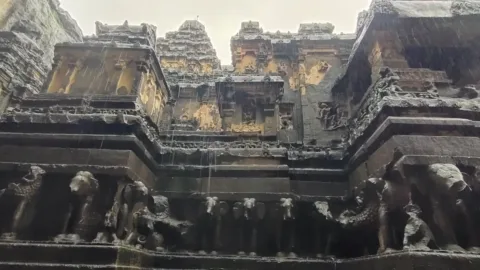
Kailasa Temple
The world’s largest rock-cut temple, carved top-down from a single rock.
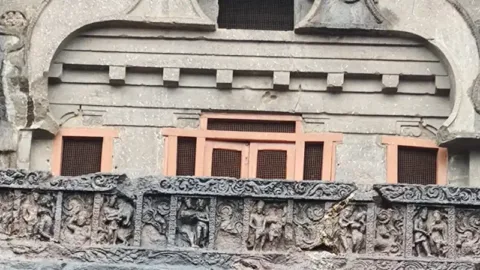
Cave 10
The ‘carpenter’s cave’, Ellora’s only Buddhist prayer hall.
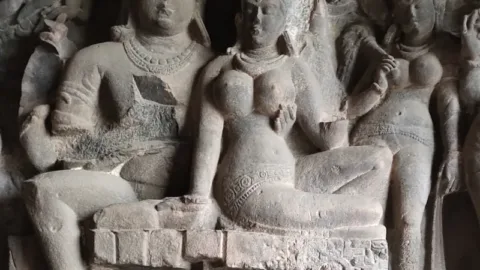
Cave 29
A grand Shiva cave guarded by lions, beside a monsoon waterfall.
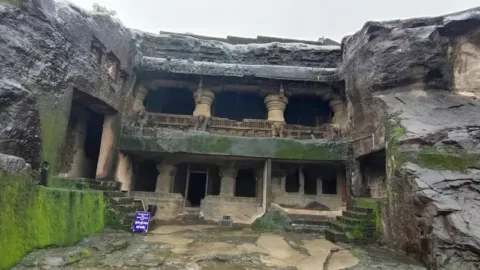
Cave 32
Indra Sabha, the finest of the Jain caves, with two storeys.
Also Visit
Cave 5, the largest Buddhist hall, with two long rows of stone benches where monks once sat together.
Cave 12 (Teen Tal), a three-storeyed monastery with rows of seated Buddhas on the top floor.
Cave 15 (Dashavatara), a two-storeyed Hindu cave with panels of Vishnu’s avatars, next to Kailasa.
Cave 21 (Rameshwar), a small, elegant Shiva cave with graceful river goddesses at its entrance.
Read more about the site’s history on Wikipedia.
Explore more iconic landmarks and city guides in our Popular Destinations section
Ellora Caves: What to See, Cave by Cave
The caves are numbered from south to north, which roughly follows the order in which the three faiths carved them. Here is what to look for in each group, with the time you need.
The Buddhist Caves (1 to 12)
Cave 5 (10 minutes)
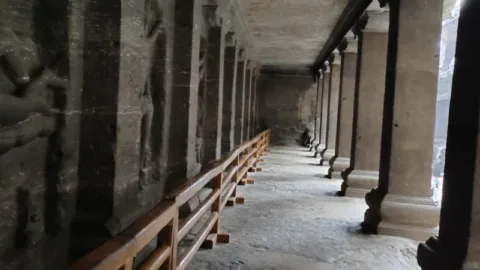
A long assembly hall, probably used for prayers and meals, with two rows of rock-cut benches running its full length.
Cave 10, Vishvakarma (15–20 minutes)
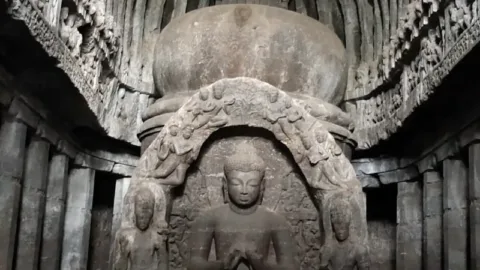
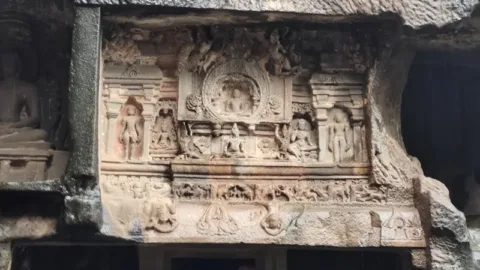
The only Buddhist prayer hall at Ellora, often called the ‘carpenter’s cave’ because its stone ceiling is carved to look like wooden rafters. A large seated Buddha sits in front of the stupa, and the hall has wonderful acoustics. Look up at the façade, with its carved window and lively figures.
Cave 12, Teen Tal (10 minutes)
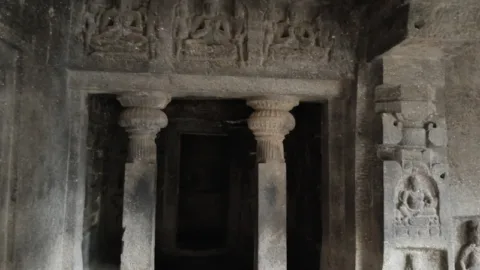
A three-storeyed monastery with a plain front that hides rows of Buddhas and Bodhisattvas inside, especially on the top floor.
Kailasa Temple (Cave 16)
Plan at least 1.5 to 2 hours here; this is the heart of Ellora.
The courtyard (30 minutes)
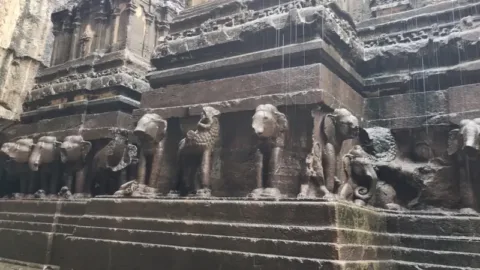
Walk around the temple at ground level. Two life-size elephants and two tall victory pillars stand in the courtyard, and the main shrine rests on a base carved with a row of elephants, as if they are carrying the temple. Don’t miss the panel of Ravana shaking Mount Kailasa, and the Gajalakshmi panel facing the entrance.
The upper level and galleries (30–40 minutes)
Climb the side stairs to the Nandi shrine and the main hall, then walk the pillared galleries around the courtyard, lined with large sculptures of Shiva and Vishnu. Traces of old paintings survive on some ceilings.
From the top (20–30 minutes)
Finish by walking up to the rim of the pit for a view of the whole temple from above.
The Hindu and Jain Caves
Cave 21, Rameshwar (10–15 minutes)
Small but beautifully carved, with the river goddesses Ganga and Yamuna at the entrance and fine Shiva panels inside.
Cave 29, Dhumar Lena (15 minutes)
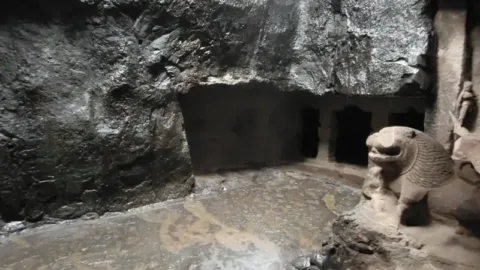
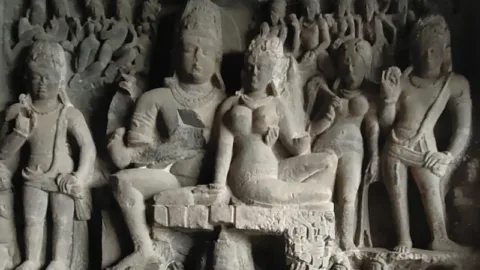
A large cross-shaped hall guarded by stone lions, with huge panels of Shiva, including his marriage to Parvati. In the monsoon, a waterfall pours down the cliff right beside it.
Cave 32, Indra Sabha (20 minutes)
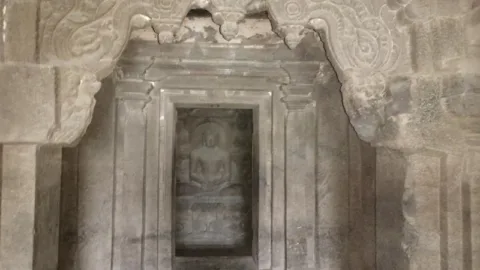
The finest of the Jain caves, with two storeys, a stone elephant and a tall pillar in the courtyard. Inside are images of Mahavira and other Tirthankaras, and Ambika seated under a mango tree. Look at Cave 33 (Jagannath Sabha) next door if you have time.
Ellora Caves: Food & Shopping
Food Near the Caves
There are small eateries and stalls near the entrance for tea, snacks and water, and a few restaurants along the road towards Khuldabad. For a local snack, try the misal pav at Jogeswari Misal & Bhel on the way to Khuldabad. Eat before you enter, as food is not allowed in the caves.
Shopping
Stalls near the entrance sell books on Ellora, postcards, stone carvings and small souvenirs. For Paithani and Himroo weaves, the silk stores in Chhatrapati Sambhajinagar have the best choice.
Ellora Caves: One-Day Itinerary
Morning: Have breakfast at your hotel and leave Chhatrapati Sambhajinagar by 7 am. The drive to Ellora takes 45 minutes to an hour. Carry water, wear comfortable shoes, and reach the gates by about 8 am, before the crowds and the heat.
8 am to 1:15 pm: Follow this plan around the caves:
- Buddhist Caves 1 to 12 (about 1 hour), with time in Caves 5, 10 and 12
- Kailasa Temple, Cave 16 (1.5 to 2 hours), including the view from the top
- Caves 14 and 15 (20 minutes), next to Kailasa
- Cave 21, Rameshwar (10 to 15 minutes)
- Cave 29, Dhumar Lena (15 minutes), and the waterfall in the monsoon
- Jain Caves 30 to 34 (45 minutes, including the battery car ride), with time in Cave 32
- Back to the entrance by battery car (15 minutes)
Short on time? Keep Kailasa in full, and see Cave 10, Cave 29 and Cave 32 for a taste of all three faiths.
Lunch (2 pm): Drive back to the city for a vegetarian thali at Shahi Bhoj Thali or Green Leaf Veg Cuisine.
Dinner: Try the other of the two for a relaxed vegetarian dinner.
Looking for short trips? Explore curated Getaways across India including beaches, forests, and heritage stays.
Ellora Caves: Travel Tips
- Don’t plan your visit on a Tuesday
- Reach by 8 am, before tour buses arrive
- Save your e-ticket offline
- Wear sturdy shoes; there are many steps
- Keep Ajanta for another day; it’s closed on Mondays
With an early start and a clear route, one day at Ellora feels complete, not rushed.
What stays with you after Ellora is the sense of patience and faith behind it: generations of sculptors removing stone, chip by chip, to reveal temples that still stand over a thousand years later.
The stories behind India’s food culture add another layer to every journey, something we explore further in our Culinary Chronicles.
Exploring more of the region? Read our Ajanta Caves guide and our Aurangabad travel guide with a 3-day itinerary.
Ellora Caves FAQs
Here are some frequently asked questions about visiting the Ellora Caves.
How much time do you need for the Ellora Caves?
Plan 5–6 hours to see the Buddhist caves, Kailasa, the main Hindu caves and the Jain caves. If you are short on time, 3 hours is enough for Kailasa and a few key caves.
Which day are the Ellora Caves closed?
The Ellora Caves are closed on Tuesdays and open from sunrise to sunset on other days. The Ajanta Caves are closed on Mondays.
What is the entry fee for the Ellora Caves?
Tickets cost ₹40 for Indians and SAARC or BIMSTEC visitors (₹35 online) and ₹600 for other foreign visitors (₹550 online). Children under 15 enter free, and one ticket covers Kailasa and all the caves.
Who built the Kailasa Temple at Ellora?
The Kailasa Temple (Cave 16) is credited to the Rashtrakuta king Krishna I in the 8th century CE. It was carved from the top down out of a single rock.
How far are the Ellora Caves from Chhatrapati Sambhajinagar?
Ellora is about 30 km from Chhatrapati Sambhajinagar (Aurangabad), a drive of 45 minutes to an hour. The city has the nearest railway station and airport.
Discover more from CookingTantra
Subscribe to get the latest posts sent to your email.